Finals tend to sneak up on you.
Between regular classes, homework and projects, it can be hard to find time to study for three or four exams.
Sometimes the hardest part is deciding which class to study for first.
This plan breaks the two weeks before finals into smaller tasks so you can spread out your studying.
Adjust it around your classes, work and other commitments.
Why start two weeks before finals?
Starting two weeks out gives you time to revisit material over several days. If you have less time, shorten the schedule.
Two methods worth trying are spaced practice (studying across several days) and active recall (testing yourself without looking at your notes). A review of learning techniques by Dunlosky and colleagues found strong support for distributed practice and practice testing.
Days 1–3: Get organized before you start studying
Day 1: Write down everything that is due
Before opening your notes, figure out what the next two weeks actually look like. Check every syllabus and collect:
- Final exam dates, times, and locations
- Remaining homework, papers, projects, and presentations
- How much each exam counts toward your final grade
Put everything on one calendar. It's easy to forget about a paper or project when you're focused on exams.
Day 2: Figure out which finals need the most attention
An exam worth 30% of your grade might deserve more time than one worth 10%. But if you're struggling in a class, give yourself extra time regardless of the exam weight.
Calculate the score you need on each final to reach your target grade. Write it next to the exam date, then decide which classes need the most work.
Day 3: Build a schedule you can follow
Start with your exam dates and work backward. Schedule more sessions for the classes you're struggling with. Try studying for 50 to 90 minutes at a time, taking breaks as needed.
Leave some room in your schedule in case a topic takes longer than expected.

Days 4–10: Learn it, then test yourself
If you've ever looked at your notes and thought you knew the material, only to get stuck on a practice problem, try changing how you study. Here's one way to use an hour:
- Review one topic (20 to 25 minutes): use lecture slides, notes or the textbook.
- Test yourself (20 to 25 minutes): close your notes and solve problems, explain a concept aloud or write down what you remember.
- Check mistakes (10 minutes): write down what you missed and start there next time.
Rotate between classes and, when appropriate, mix different types of practice problems.
Days 11–12: Take practice exams
Use a past exam from your professor if one is available. Otherwise, assemble questions from old quizzes, homework, and practice sets. Set a timer, put away your phone, and follow the same open- or closed-note rules as the real test.
Check your answers and figure out why you missed each question. If you have several finals, you may only have time for full practice tests in your toughest classes.
Days 13–14: Review weak spots and rest
Redo problems you missed on your practice tests and review the concepts you're still unsure about. If you get stuck, ask a classmate or visit office hours if they're available.
Make time for sleep. The American Academy of Sleep Medicine recommends at least seven hours per night for adults. Avoid trading a full night of sleep for more last-minute studying.
What to do during finals week
- Night before: look over a short summary; double-check the exam time and location.
- Morning of: eat, bring your materials, and arrive with enough time.
- Between exams: take a real break before shifting to the next subject.
Your 14-day finals plan at a glance
| When | What to do |
|---|---|
| Day 1 | List exams and deadlines |
| Day 2 | Calculate target grades and priorities |
| Day 3 | Build your study schedule |
| Days 4–10 | Review, test yourself, track mistakes |
| Days 11–12 | Take practice exams and analyze mistakes |
| Days 13–14 | Review weak areas and rest |
If an exam falls before the end of the two-week period, move its practice exam and final review to the days leading up to it.
Make finals easier with Arcavelo
Arcavelo is a student organization app designed to help you keep track of coursework, deadlines and grades in one place.
If you prefer to plan digitally, you can use Arcavelo to organize your semester instead of keeping separate lists for each class.
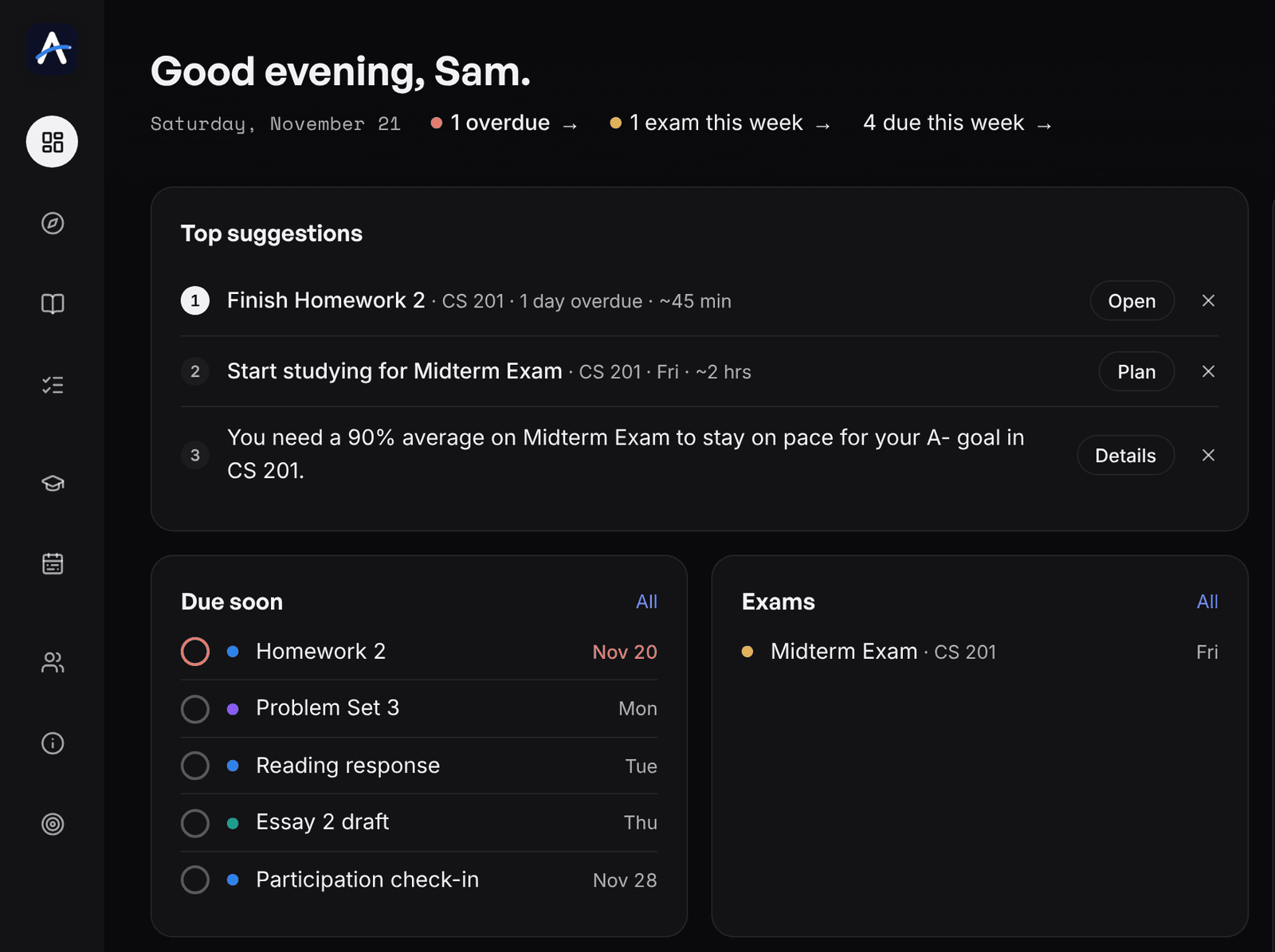
Get started at https://arcavelo.app/
If you fall behind
Some topics will take longer than you expect. If you miss a study session, move the most important work to your next available block rather than trying to make up everything in one night.
Start by listing your exams and deadlines today.
Sources and further reading
- Dunlosky, J., et al. (2013). Improving Students’ Learning With Effective Learning Techniques. Psychological Science in the Public Interest, 14(1), 4–58.
- Roediger, H. L., & Karpicke, J. D. (2006). Test-Enhanced Learning: Taking Memory Tests Improves Long-Term Retention. Psychological Science, 17(3), 249–255.
- Watson, N. F., et al. (2015). Recommended Amount of Sleep for a Healthy Adult. Sleep, 38(6), 843–844.